A38 Derby Junctions Road Upgrade: £600M Contract and Market Engagement Overshadowed by Project Failures
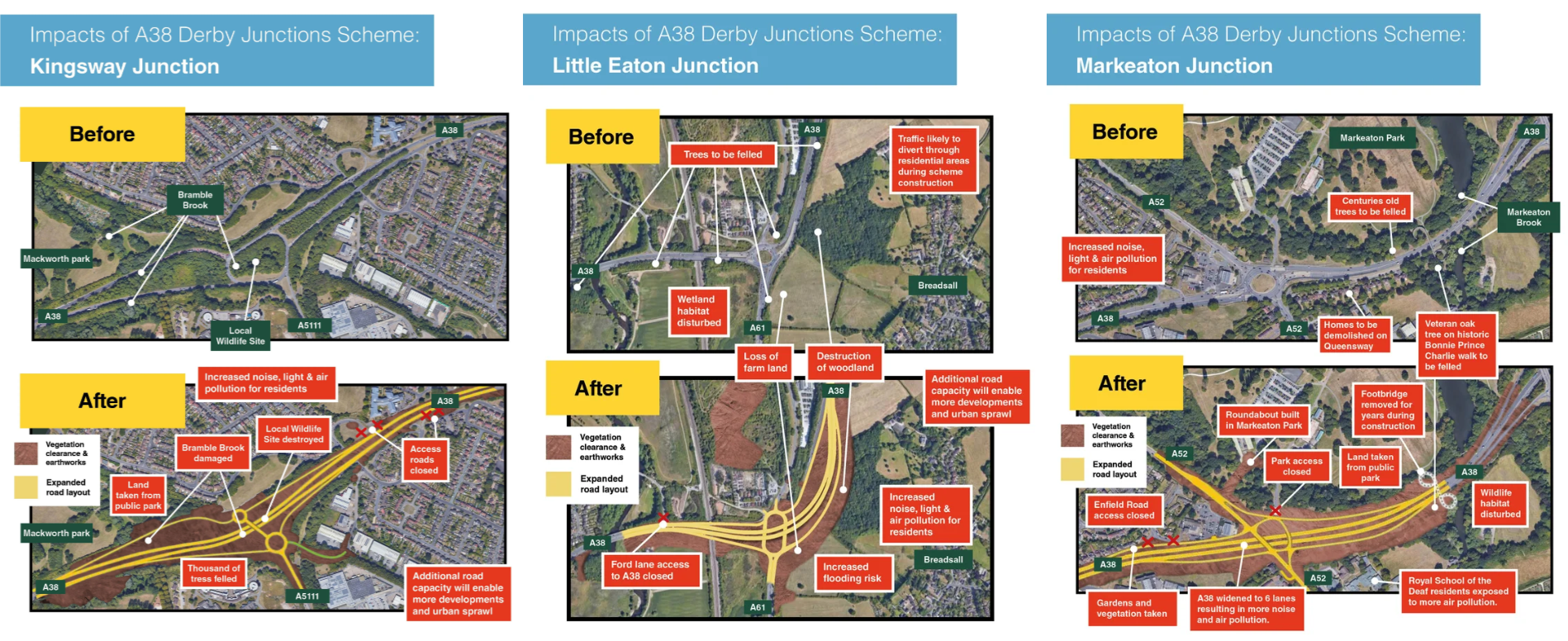
Before and after visualisations of the impacts of A38 Derby junctions schemes.
National Highways’ publication of a preliminary market engagement notice for the long-delayed A38 Derby Junctions scheme, now estimated at £600 million and set to run for ten years, should not be mistaken for progress.[1]
Originally budgeted at £200–250 million, it has more than doubled in cost. National Highways and ministers now suggest that legal challenges and inflation are to blame.
That narrative is convenient.
It is also misleading.
The A38 is not a victim of vexatious legal challenges. It is a project repeatedly exposed for weak appraisal, unlawful approval and economic obsolescence, problems of the Government’s own making both under Conservatives and Labour.
This is an outdated, poorly justified road expansion project propped up by weak governance. The scheme was part of the Labour Government's infrastructure spending review from 2024 - 25.[2]
The increased scheme costs have been known since July 2025 as the Office for Road and Rail published a report on National Highways performance. It’s worth noting legal challenges are not noted as a reason for increased costs and the Lower Thames crossing has faced the greatest increases in costs but never dealt with a legal challenge.[3]
As the A38 scheme has spiralled in cost, there remains no Full Business Case, no published Accounting Officer Assessment. The Information Commissioner’s Office has ruled that National Highways must disclose the information used by Government to approve the A38 expansion in last year’s Spending Review. National Highways is appealing the decision and the Department for Transport is delaying a related internal review on the cancellation of Midlands Main Line electrification, raising serious concerns about transparency in how these major funding decisions were made.[4]
National Highways has blamed the legal challenges for rising A38 costs yet conveniently failed to share any details about those legal challenges.
Both legal challenges to the scheme were the result of concerns raised during official examination processes that were ignored.
The first challenge succeeded because the then Secretary of State for Transport, Grant Shapps conceded the approval was unlawful — the scheme was permitted to proceed without properly considering its cumulative carbon emissions, despite significant environmental and climate harms documented in National Highways’ own planning documents.
The second challenge focused on the failure to update the economic case. During the 2022 re‑examination phase, stakeholders highlighted that the Benefit‑Cost Ratio (BCR) relied on outdated data, yet National Highways refused to recalculate it in line with updated guidance. The judicial review was permitted to proceed because the argument was credible. However the court ruled that the Secretary of State for Transport was permitted to approve a scheme with out of date information because this information would be updated at the full business case stage before final approval.
To date there is still no Full Business Case and no comprehensive economic assessment justifying the claimed benefits relative to the costs and significant environmental and community harms. Shockingly, a Combined Modelling and Appraisal (ComMA) report was never produced during the scheme’s examination.
Now the costs are over the £500 million mark, the scheme is now part of the Government’s Major Projects Portfolio (GMPP) which requires greater scrutiny and sign off. Yet there is no Accounting Officer Assessment.
The Government has also signalled they are reviewing GMPP schemes due to fiscal constraints.[5]
The consequences of ignoring these warnings are now clear. With costs escalating from around £250 million to over £600 million, the BCR has collapsed, exposing the scheme as far less economically viable than claimed and raising serious questions about value for money.
An FOI request revealed that during the spending review, ministers knew the scheme’s BCR was updated to 1.11, down from 2.6 in 2019.
During the second legal challenge National Highways updated the BCR to 2.4 but withdrew that calculation when evidence showing the BCR could be below 2 was presented to force that evidence to also be withdrawn from the case.
Worse, the cost estimate has exploded and the costs estimated during the spending review are being concealed, potentially lowering the BCR to below 1, meaning the scheme loses money and offers no return on investment.
In 2015, the A38 Derby Junctions' BCR was reported as 6.1 in the Road Investment Strategy's economic analysis.[6] By 2018, during the examination procedure, the BCR had declined to 2.6.[7] The Examining Authority noted the lack of information on the methodology and assumptions used in the economic assessment and requested a full version of the assessment. National Highways only provided a table summarising the Analysis of Monetised Costs and Benefits (AMCB), showing the BCR of 2.6 based on 2010 market prices.
Had National Highways updated the BCR properly when it was flagged in either 2018 or 2022, the risk of runaway costs and diminishing returns could have been apparent years earlier. Instead, the public has been kept in the dark while decisions worth hundreds of millions are made behind closed doors.
The scheme itself has long benefitted from design assumptions frozen in time. National Highways claims the flyovers and underpasses will improve traffic flow, but evidence published in its own assessments shows that many traditional road capacity projects fail to deliver sustained congestion relief and often generate induced demand that increases traffic rather than reducing it.[8]
No multi-modal alternative solutions were ever explored. This scheme, which was designed over 10 years ago, is primarily aimed at increasing road capacity for unsustainable, car-dependent developments.
When the examining authority asked why only road-based solutions were proposed, National Highways replied that in 2001 a “road-based study” was commissioned rather than a “multi-modal study”, and that the solution to the problems on the A38 were clearly perceived to be road-based options.[9]
That decision, made in 2001, continues to shape a £600 million infrastructure commitment in 2026.
The scheme planning documents show a net loss of vegetation and green space, the complete destruction of a wildlife site, increased traffic levels, increased noise, increased carbon emissions and increased regional air pollution. Houses, public park space and farmland will be compulsory purchased, demolished and constructed over.
The project will result in the permanent loss of 11.38 hectares of woodland, with only 6.40 hectares planned for replanting. According to National Highways' own biodiversity statement, the scheme will result in the complete destruction of the A38 Kingsway Roundabout Local Wildlife Site.
Construction is expected to last four years, during which traffic will divert through Derby city centre and residential areas. No traffic mitigation plan is in place.
National Highways and Derby City Council expect that air quality legal limits risk being breached during construction, while after completion, NO2 emissions will be higher in several areas, including near Derby’s Royal School for the Deaf.
Public consultations for the scheme received only 739 responses. The consultation materials by National Highways were heavily biassed in favour of the scheme, only proposed road based options, exaggerated the benefits and did not fully explain the negative impacts of the scheme.[10]
This is being sold as congestion relief. It is, in practice, years of disruption and environmental harm to enable capacity expansion to benefit poorly planned, unaffordable, car dependent housing developments near the A38. The only beneficiaries of this scheme will be the private housing developers who claim housing numbers are restricted to the A38’s capacity. There has been no effort whatsoever by developers, Government or National Highways to consider multi-modal transport alternatives and smarter developments to relieve congestion and facilitate housing growth.
Despite this, and despite the absence of a current economic case or published governance assessments, ministers continue to portray legal challenges as the cause of delay.
In reality, the Government’s own failures; ignoring environmental impacts, disregarding economic warnings, refusing to consider multi-modal solutions, and refusing transparency, have created nearly all of the delays and risks associated with the A38 project.
At £600 million and rising, this scheme remains an expensive, avoidable fiasco. Until the Government publishes the Full Business Case, releases the withheld Spending Review evidence, and demonstrates that updated economics support the project, the public cannot have confidence that the A38 Derby Junctions scheme represents good value for money or coherent transport policy.
Footnotes
[1] National Highways engages on £600M, 10-year contract for A38 Derby Junctions scheme, New Civil Engineer, 20 Feb 2026. https://www.newcivilengineer.com/latest/national-highways-engages-on-600m-10-year-contract-for-a38-derby-junctions-scheme-20-02-2026/
[2] Announcement of the 'pause' for Phase 3 of Midland Mainline electrification whilst approving funding for A38 Derby Junctions, Government Press Release, 8 July 2025. https://www.gov.uk/government/news/green-light-for-over-50-road-and-rail-upgrades-supporting-over-39000-new-homes-and-42000-jobs
[3] Cost increase of A38 scheme on Page 77 of ORR National Highways financial monitoring data, July 2025. https://www.orr.gov.uk/sites/default/files/2025-08/annual-assessment-of-national-highways-performance-2024-2025-web.pdf
[4] Information Commissioner’s Office Decision Notice IC-438853-P5Q9 (2025), requiring disclosure of Spending Review information relating to the A38 scheme. National Highways has appealed; tribunal pending. https://ico.org.uk/action-weve-taken/decision-notices/2025/12/ic-438853-p5q9/
[5] NISTA is currently undergoing a review of the Government Major Projects Portfolio. https://questions-statements.parliament.uk/written-questions/detail/2025-12-18/101389
[6] UK Department for Transport. (2015). Economic Analysis of the Road Investment Strategy. https://assets.publishing.service.gov.uk/media/5a7f6f1b40f0b62305b871f5/ris-economic-analysis.pdf
[7] Planning Inspectorate. (2018). A38 Derby Junctions Responses. https://infrastructure.planninginspectorate.gov.uk/wp-content/ipc/uploads/projects/TR010022/TR010022-000796-TR010022_A38_8.5_Responses_to_ExA_First_Written_Questions.pdf
[8] National Highways Pinch-Point Programme meta-analysis. https://assets.publishing.service.gov.uk/government/uploads/system/uploads/attachment_data/file/791450/National_PP_Programme_Meta_Final_draft.pdf
[9] Planning Inspectorate, A38 Derby Junctions Responses to ExA First Written Questions. https://infrastructure.planninginspectorate.gov.uk/wp-content/ipc/uploads/projects/TR010022/TR010022-000796-TR010022_A38_8.5_Responses_to_ExA_First_Written_Questions.pdf
[10] National Highways, A38 Derby Junctions Public Consultation Materials. https://nationalhighways.co.uk/our-roads/east-midlands/a38-derby-junctions/