A credible alternative to A38 road expansion: a Derby tram network
A serious, costed public transport alternative for Derby is now on the table.
The Light Rail Transit Association (LRTA) has published a detailed proposal for a four-line Derby tram network, with an estimated total cost of around £500 million. The scheme is designed to shift large numbers of journeys away from private cars, cut congestion and pollution, and support long-term regeneration of Derby city centre and key employment sites.
This proposal directly reinforces what we have been saying throughout the A38 campaign: hundreds of millions of pounds would deliver far greater benefits if invested in public transport rather than road expansion.
What is being proposed?
The tram network would consist of four interconnected lines, using a mix of off-street alignments, former railway corridors and roadside reservations to maximise reliability and keep costs down.
In summary, the proposal would:
Connect major employment sites including Rolls-Royce, Infinity Park and Raynesway
Link Derby city centre, the railway station, the university and the Royal Derby Hospital
Serve large residential areas including Mickleover, Mackworth, Allestree, Chellaston, Alvaston and Spondon
Provide a potential connection to Nottingham’s NET tram system in the east
The LRTA estimates that a fully built network could carry around 75,000 passenger trips per day, with the busiest central section handling up to 60,000 daily trips, the majority diverted from car travel.
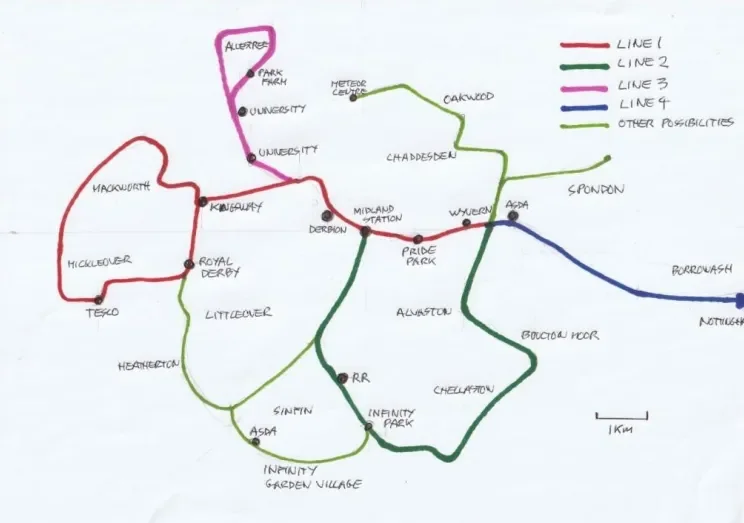
Map of proposed Derby tram network
Why this matters for the A38 debate
Key advantages highlighted in the proposal include:
Much better value for money than the A38 Derby Junctions road scheme, now expected to cost £650 million or more
Direct congestion reduction, rather than induced traffic
Lower environmental and health impacts, including reduced air pollution
Stronger support for city-centre regeneration, rather than car-dependent sprawl
The ability to deliver the network in phases, starting with the highest-impact routes
Notably, the authors explicitly state that Lines 1 and 3 would do more to relieve A38 traffic than the road scheme itself, while delivering wider economic and social benefits.
Media coverage
The proposal has already attracted national and regional attention:
BBC News:
Transport group suggests £405m Derby tram network
https://www.bbc.co.uk/news/articles/c5y2vl5w4jwoNew Civil Engineer:
£500m Derby tram scheme with four lines proposed
https://www.newcivilengineer.com/latest/500m-derby-tram-scheme-with-4-lines-proposed-08-01-2026/Derby Telegraph:
Huge £405m Derby tram network proposed that could “rejuvenate” the city centre
https://www.derbytelegraph.co.uk/news/derby-news/huge-405m-derby-tram-network-10741101
The bigger picture
Derby currently has very low public transport use and high car dependency, despite worsening congestion, air quality problems and rising infrastructure costs. The tram proposal sets out a realistic, evidence-based alternative that aligns with modern transport planning, prioritising reliability, connectivity and long-term value.
At a time when public spending is under intense pressure, this raises a fundamental question:
Why commit escalating sums to an outdated road expansion, when a credible, costed public transport solution exists?