Campaigners condemn Government budget after FOI uncovers huge cost surge and hidden concerns
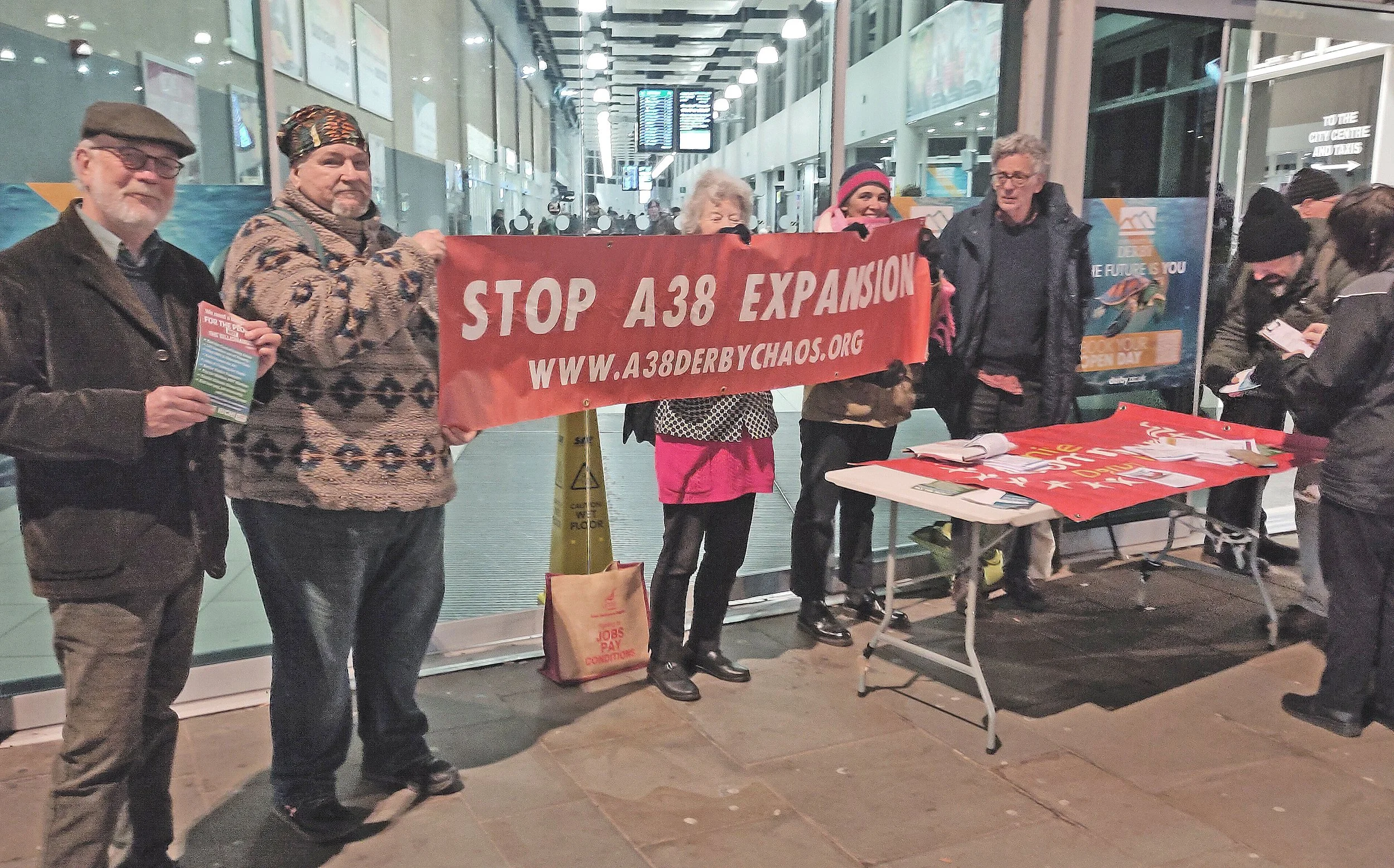
Campaigners from Derby People’s Assembly and Unite Community were joined by the Stop the A38 Expansion campaign at Derby bus station on Wednesday 26 November, the budget day, to hand out leaflets calling for “A budget for people. Not the billionaires”.
A spokesperson for the A38 campaign said:
“While the budget hits working people with stealth tax rises like frozen income tax thresholds, over £637 million is being poured into a destructive, polluting road scheme in Derby with billions more into other similar road schemes all over the country.
Instead of bankrolling pointless road schemes that mainly benefit corporate lobbyists, the Government should invest in clean, affordable public transport that actually reduces congestion and pollution, boosts the economy and serves the public.”
Earlier this year, the Office of Rail and Road revealed that the projected cost of the A38 Derby Junctions scheme had increased by £464 million compared with National Highways’ earlier estimates. A recent freedom of information (FOI) request to National Highways about the ORR costs revealed that the A38 is now officially estimated at £637 million.
Internal emails released through the FOI reveal senior Department for Transport officials expressing concern over the escalating A38 costs, driven largely by inflation, construction cost rises, and delays. The correspondence also shows concern within the Department about this information being released while the project still has no contractor in place, with officials warning that unpublished cost data could “undermine commercial negotiations”.
Campaigners criticised the Government’s claim that the A38 expansion will unlock nearby land for over 15,000 new homes, warning that these developments will be car-dependent, increase congestion, and place extra pressure on already overstretched schools, GP surgeries and public services. They say the A38 is being expanded specifically to accommodate the extra traffic generated by these new private developments.
They also highlighted how major housing developers have been lobbying the Government to accelerate housebuilding without regard for whether new estates are sustainable or connected to public transport. Developers favour building on greenfield and agricultural land because it yields higher profit margins, leaving taxpayers to fund the destructive road schemes needed to service these car-dependent estates.
Campaigners stressed that investment in affordable buses would support far more people during the cost-of-living crisis. Research from the Social Market Foundation shows that around 5 million people in the UK are pushed into poverty by transport costs alone, with driving being the most expensive form of transport, meaning reliable buses remain an essential lifeline for many households.
They added that there are far better ways to spend public money on transport than funnelling hundreds of millions into the A38 expansion. For example, electrifying the Midlands Main Line would create thousands of local jobs, strengthen the regional economy, and deliver cleaner, faster rail services for thousands of passengers.
Whether improving buses or modernising rail, these investments would help people directly, reduce emissions, and build a transport system that works for communities rather than private developers.
“This Government is choosing developers over communities,” the campaign added. “People need reliable buses and modern rail, not years of roadworks and even more traffic.”
Footnotes:
1. Earlier this year an ORR report revealed that A38 costs had increased. Page 77, ORR National Highways financial monitoring data, July 2025.
https://www.orr.gov.uk/sites/default/files/2025-08/annual-assessment-of-national-highways-performance-2024-2025-web.pdf
2. An FOI request to National Highways about the ORR costs revealed that the A38 is now officially estimated at £637 million.
https://www.whatdotheyknow.com/request/correspondence_between_the_orr_a/response/3218146/attach/html/7/Copy%20of%20ORR%20Q4%20Detailed%20Tables%20Final%20Submission%20REDACTED%20SUMMARISED.pdf.html
3. In the same FOI request, it was revealed that the Department for Transport’s Director for Roads and Projects Infrastructure Delivery had emailed the Office of Rail and Road regarding the rising A38 costs.
https://www.whatdotheyknow.com/request/correspondence_between_the_orr_a/response/3218146/attach/html/5/Annual%20Assessment%20for%20RIS%202%2021082025%20Redacted.pdf.html
The email stated:
“Thanks for the catch up earlier in the week. I wanted to touch base, albeit in hindsight, on your Annual Assessment of RIS2 published in July. On page 77, you identify the largest cost increases to outturn forecast. I wanted to check your source for this data, and whether it was formally change controlled.
Much of the forecast cost increase is linked to later start dates, and potentially elongated construction schedules to fit in with funding availability and a combination of prolongation, wider inflation, and construction inflation/raw materials running higher than generic inflation. But it would be useful to know the source of the data, whether NH had officially change controlled it, and the associated construction schedules. I am obviously concerned about rising costs, but understanding the fuller background would be useful. These issues don’t really come out in the narrative.
In addition we are always nervous about unpublished data being released out of context. Also A38 is without a contractor so I’m hoping this doesn’t undermine commercial negotiations. Any help you can give would be much appreciated. Thanks.”
4. Research from the Social Market Foundation on transport poverty.
https://www.smf.co.uk/5-million-people-driven-into-poverty-by-transport-costs/
Transport is the single largest household expense (excluding mortgages) for rural families, and the second largest for urban ones. Over 5 million people (8% of the population) are pushed into poverty by transport costs. Cars are the most expensive mode of transport; the median UK household spends £5,944 a year on transport, of which £5,740 is spent on driving. Poorer regions with limited public transport see the highest rates of transport poverty (e.g., 12.5% in the North East vs 3.5% in London). Fuel duty freezes have saved the median household only £13 per month while costing the Exchequer £100bn. Reinvesting in public transport—especially improving speed relative to driving—could save households over £434 per year.
5. Rail industry leaders urge action on Midland Main Line electrification after its ‘pause’. Joint letter from the Rail Forum and Rail Industry Association to Rail Minister Lord Hendy, 14 July 2025.
https://www.riagb.org.uk/RIA/RIA/Newsroom/Press_Releases/Midland_Main_Line_action_urged.aspx
The letter warns that keeping this key rail upgrade under review could cost taxpayers £50–£70 million, risk nearly £400 million in economic benefits, and jeopardise the creation of almost 5,000 jobs.