We've submitted our case for cancelling the A38 Derby Junctions scheme
Last week, Stop the A38 Expansion Campaign submitted its formal response to the Department for Transport's consultation on cancelling the A38 Derby Junctions and A46 Newark Bypass schemes. Our response draws on years of evidence gathering, Freedom of Information requests, planning documents, expert analysis, and a survey of 235 of our own supporters, and it makes the case, in full, for why this scheme should be cancelled for good.
We're publishing the whole thing below, rather than just a summary, because we think the evidence should speak for itself. This isn't a campaign built on slogans. It's built on what the scheme's own evidence actually shows: a disruptive scheme that risks making congestion worse, not better, a wildlife site and centuries-old trees that will be destroyed, carbon emissions that rise rather than fall, and a design that locks Derby into car dependency at exactly the moment national policy is trying to move away from it. We wanted anyone, supporter, journalist, councillor, or DfT official, to be able to read exactly what we said, not a shortened version of it.
Alongside this response, we also submitted an independent report on alternatives to the A38, prepared by a transport consultant, setting out for the first time what a genuine alternative package for this area could look like and roughly what it might cost. We'll be publishing more on that separately.
Thank you to everyone who helped get us here, whether you filled in the consultation, completed our supporter survey, or simply kept believing this fight was worth having. Here's what we told the Department for Transport.
RIS3 Variation Consultation Response by Stop the A38 Expansion Campaign
We are Stop the A38 Expansion Campaign (a38derbychaos.org), a Derby-based community campaign that has opposed the A38 Derby Junctions scheme since 2019. This response is backed by a survey of 235 of our supporters, completed in August and September 2026, summarised throughout and set out in full in the annex.
Q5: Support or oppose
Support proposed changes: cancel the A38 Derby Junctions scheme.
Q6: Reasons for response
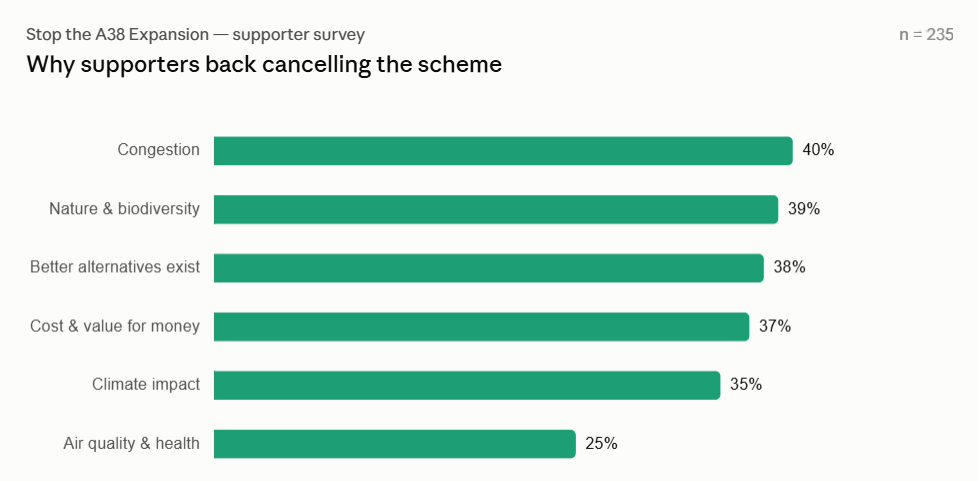
When we asked our supporters why they support cancellation, these are the reasons mentioned.
Congestion the scheme won't fix — in 40% of responses
Nature and biodiversity harm — in 39% of responses
Better alternatives already exist — in 38% of responses
Cost and value for money have collapsed — in 37% of responses
Climate impact — in 35% of responses
Air quality and health — in 25% of responses
We set out the evidence behind each of these below, in the order our supporters raised them.
1. Congestion: this scheme will not fix it, and could make it worse
The scheme's own modelling shows why. Road-user carbon emissions on the corridor are forecast to rise from 856 tCO2e at opening to 2,723 tCO2e by 2039, an increase that only happens if traffic keeps growing after the scheme opens, not falling. Rising emissions from opening onward is the signature of induced demand: added capacity generates additional traffic rather than relieving it.
Derby City Council's own analysis of the applicant's traffic model found significant traffic increases at ten local junctions as a direct result of this scheme. National Highways said in a Statement of Common Ground that worsening local roads is "an inevitable effect" of the scheme and leaves the Council to sort out the mitigation.
The traffic model shows 9 of 26 assessment routes get worse in the AM peak by 2039; 7 get worse in the PM peak.
The 89.9 million person-hours-saved figure comes from a model with no published methodology report, so it cannot be independently checked.
National Highways' own 2017 review (the Pinch Point Programme meta-analysis) found most similar schemes failed to relieve congestion at all.
Is the traffic model used for this scheme TAG compliant on variable demand, and if not, what was the compelling reason for not using one?
The housing justification for this scheme undermines its own congestion case. The scheme's own evidence gives three different, unreconciled housing figures: the Secretary of State's Decision Letter says a minimum of 11,000 homes, National Highways' own FOI-disclosed spreadsheet says 7,894 with the "dependent homes" column left blank, and the current figure being used is 43,000.
None of these has ever been tested for whether the homes actually depend on this scheme, and the traffic modelling underneath the scheme has not been updated since 2019, despite that near-fourfold spread in the number of homes it's supposed to be planning for. Every one of those homes adds car trips to the same junctions the scheme claims to fix and the traffic will obviously not be confined to the A38 and will spill onto the local road network.
The DfT's own Integrated Transport Strategy states plainly that increasing road capacity alone is often the default choice for new developments, but that this increases car dependence and leads to more congestion, not less, when homes are built without proper sustainable transport provision from the outset. This scheme repeats that mistake at scale: it treats new housing as a reason to widen the road, when the evidence says that is exactly what locks in the congestion it claims to solve.
Housing should be designed close to local amenities and provide frequent, reliable public transport links and safe active travel routes. Otherwise it risks entrenching further car dependency and worsening congestion, air pollution and carbon emissions.
Sources: Derby City Council Local Highway Impact Report, Section 8 (TR010022-000814); Statement of Common Ground with Derby City Council, p.52 (TR010022-000841); TAG Unit M2.1, Variable Demand Modelling; National Pinch Point Programme meta-analysis (2017)
2. Nature and biodiversity
The scheme wipes out the A38 Roundabout Local Wildlife Site completely. The Examining Authority and the Secretary of State both recorded this as a significant adverse effect, even after mitigation, and both weighed it against approval before granting the Development Consent Order anyway. The updated Annex A now rates the scheme as "slight beneficial." to biodiversity despite the scheme’s own planning documents stating:
11.8 hectares of mature trees felled, including a veteran oak.
Only around half that area planned for replanting.
Complete loss of the A38 Roundabout Local Wildlife Site - a confirmed significant adverse effect.
Sources: ES Chapter 8 Biodiversity [APP-046]; Secretary of State's Decision Letter
There are no biodiversity net gain requirements for this NSIP as the BNG requirements are not applied retrospectively to scheme’s with DCOs. We are also concerned that any new trees will not be maintained and watered and risk dying off. This happened with over 800,000 trees planted as mitigation by national Highways for the A14 road scheme.
39% of respondents named nature and biodiversity harm, unprompted, as a reason for backing cancellation, the joint-highest reason of any listed in this response. Markeaton Park itself came up again and again in their own words. Supporters called it one of Derby's most-visited green spaces, raised the loss of mature trees around it specifically, and said a motorway-style road running this close to the park would damage a place that matters to the whole city, not just people living nearby.
The evidence above and what our supporters are telling us point the same way, just from different angles. The scheme's own documents confirm real, lasting harm to nature here. The people who actually walk through and near Markeaton Park are saying the same thing in their own words. Losing centuries-old trees isn't a minor trade-off to the people who live alongside them. It's one of the clearest reasons they want this scheme stopped.
3. Better alternatives already exist
National Highways confirmed to the Examining Authority that the solution was fixed as road-based back in 2001, before any of today's climate, housing or transport policy existed. No multi-modal study has ever been done for this corridor. That's not just an oversight, it's now directly at odds with the government's own national strategy. DfT's own Integrated Transport Strategy (April 2026) states that increasing road capacity alone is often the default choice for new developments, but that this increases car dependence and leads to more congestion and worse health outcomes, not less. This scheme is the strategy's own warning example, not an exception to it.
The economic case for public transport over road capacity is not just environmental, it's about growth. Centre for Cities research finds that poor public transport, combined with low-density urban development, costs the UK over £21 billion a year in lost productivity, with less than half of people in big cities outside London able to reach their own city centre quickly by public transport. That is the productivity gap the East Midlands actually has. A scheme that spends £600m+ widening three road junctions does nothing to close it; investment in bus, rail and active travel does, by connecting more people to more jobs, not just moving the same congestion further down the road.
Housing has to be part of the same answer, not treated separately from it. New homes should be built at higher density, close to shops, schools and jobs, and genuinely well connected by public transport and active travel from the outset, not bolted onto a road network afterwards and left to add to the traffic. Paired with demand management measures, like the workplace parking levy and off-peak scheduling options raised elsewhere in this response, that kind of development actually reduces car dependency instead of building more of it in. Widening three junctions does the opposite: it makes car-dependent, low-density growth easier to build, locking in exactly the pattern DfT's own strategy warns against.
An independent alternatives study (Mobility Lab, "One Network for Derby") shows a deliverable bus, walking and cycling package fits within the money already committed to these three junctions.
Rail options include reopening the Kirkby–Erewash Valley freight branch to passengers, a direct Derby–Mansfield service via the underused Trowell Junction–Toton–Trent line, and a new station at Clay Cross.
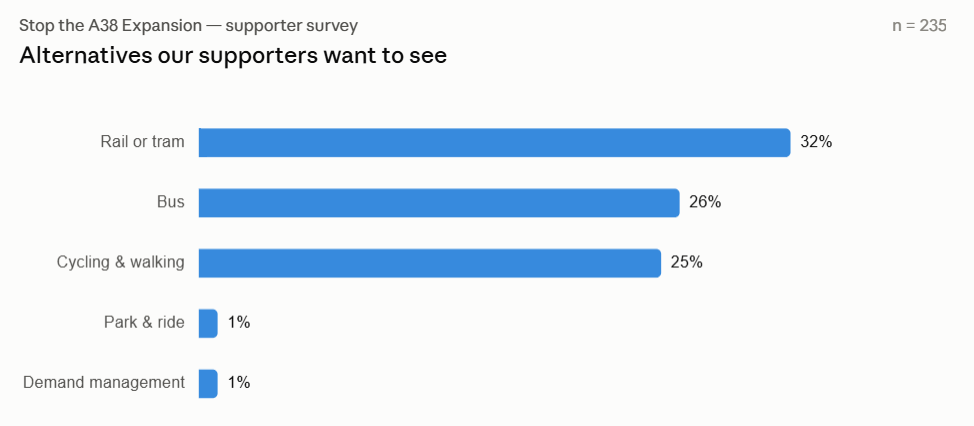
When we asked our own supporters for alternatives: 32% said rail or tram, 25% said active travel, 25% said bus investment.
Nearby, the case for road-only thinking has already failed a real test: a Strategic Outline Business Case for the Maid Marian rail line assessed A38-area road improvements as performing worse than doing nothing at all. The A38 Derby Junctions scheme is worse than doing nothing at all. It increases traffic, risks worsening the local road network, raises carbon and NO2 emissions, disrupts the local community and severs paths during years of construction, and destroys nearly 12 hectares of mature trees along with the biodiversity they support.
That said, we'd rather local authorities and the East Midlands Mayoral Authority invested in better bus services, active travel networks and revenue-generating demand management schemes than did nothing at all. Excessive car use in and around Derby causes congestion across the whole road network, adds to air pollution, and makes the city a worse place to walk or cycle.
Sources: Mobility Lab, One Network for Derby (once finalised); Maid Marian Line Strategic Outline Business Case, Derbyshire County Council
4. Cost and value for money have collapsed
This scheme has no published Full Business Case and no Accounting Officer Assessment and the Examining Authority questioned the lack of economic modelling data during the scheme’s examination. The scheme was quietly removed from Government Major Projects Portfolio oversight as the Government increased the threshold from £500m to £1bn that would have triggered independent scrutiny.
Cost has risen from £200–250m in 2019 to over £646m now, confirmed by ORR monitoring in July 2025 and National Highways' own market engagement notice in Feb 2026 stated £600m.
The benefit-cost ratio was recalculated to 1.611 in the August 2026 Annex A update, using a revised freight value of time methodology, up from 1.11 under the previous methodology. DfT has not published what cost base this revised figure is calculated against, so it is impossible to tell whether it reflects the £590m cost position from October 2024, the £646m figure confirmed by ORR in July 2025, or something else entirely. A BCR that rises purely on the back of a methodology change, without disclosing the cost figure it's being measured against, is not evidence that the scheme's value for money has genuinely improved. On the scheme's own cost trajectory, cost has only ever gone up, and DfT should be asked to confirm what cost base the 1.611 figure uses, and what the BCR would be if it were recalculated using the same revised freight methodology against the current £646m+ cost position rather than an unstated, and likely outdated, one.
Roughly 90% of the scheme's claimed benefit is notional driver time savings, a methodology that decades of National Travel Survey data show does not hold up: people spend saved time travelling further, not saving it.
The freight time-saving case doesn't stand up either. Only around 8% of A38 traffic is freight, down from 10% in 2021, and there's no published data on where that freight is actually going or how far it travels on this corridor. Even if a few minutes are saved, nobody has shown how that translates into any real economic benefit at all, let alone one that reaches local people struggling with the cost of living.
This scheme is also being sold as a benefit to the whole region, when in practice it can only ever benefit people who drive, and even that is doubtful given the evidence above.
22% of households in England have no access to a car at all. That rises to 31% among the lowest-income households, more than four times the rate for the highest-income households, and to 30% among disabled adults, against 14% of non-disabled adults. A scheme built entirely around saving drivers minutes does nothing for the people already least able to afford to drive, and does nothing to address the cost of car ownership itself, at a time when the cost of living is the public's most pressing concern. Investment in buses, rail and safe walking and cycling routes is a fairer use of public funds that delivers more productivity, jobs, connectivity and co-benefits to public health and the environment
Even taken on its own terms, the wider evidence that road schemes deliver the economic growth claimed for them is thin. A government-commissioned review found only 28% of past schemes had journey-time benefits within 15% of their original forecast, and only 74% within 50%. The What Works Centre for Local Economic Growth's meta-analysis of around 2,300 transport-project evaluations found only 17 robust studies of road schemes' effect on local economies, the majority showing no, or mixed, employment effects. Reviews of National Highways' own Post-Opening Project Evaluations found there was "either no evidence, weak negative evidence, or anecdotal evidence" for the growth that past schemes were justified on.
Journey time savings are given far more weight in this scheme's case than the evidence supports, and the underlying data cannot even say who those minutes are being saved for. National Travel Survey data does not break down journeys on this corridor by purpose, business, commuting, education or leisure, so nobody, including National Highways, can say how many of the claimed benefits are going to economically productive trips at all, as opposed to journeys that have no bearing on growth or productivity whatsoever.
A scheme with a falling BCR, a cost base that keeps rising, a benefit that flows only to drivers while ignoring transport inequality and the cost of living, and a growth case the government's own evidence does not support, is not sound value for money by anyone's definition, including the government's own.
Sources: ORR financial monitoring, July 2025; National Highways preliminary market engagement notice; Metz (2017), National Travel Survey time-series analysis; DfT Value for Money Framework; DfT National Travel Survey 2024, household car access; Health Foundation, Trends in households without access to a car (NTS 2023–24); DfT NTS 2024, Disability; What Works Centre for Local Economic Growth, transport evaluations meta-analysis; National Highways Post-Opening Project Evaluations reviews
5. Climate: this scheme increases emissions, not decreases them
35% of our supporters named climate impact, unprompted, as a reason for backing cancellation, and they want the same thing this response is asking for: investment in public transport, not more roads that make the problem worse.
The scheme's own modelling shows scheme-attributable emissions rising from 856 tCO2e at opening to 2,723 tCO2e by 2039, before adding 130,858 tCO2e of construction carbon and a confirmed adverse impact of 481,012 tCO2e over its 60-year life. Rising emissions from opening onward is the signature of induced demand, whatever the scheme's case calls it.
This is not a distant risk. Defra and the Environment Agency declared half of England in drought on 29 July 2026, the third drought in five years. Two weeks later government judged wildfire risk severe enough to issue an Emergency Alert and deploy troops. The same government identified the A38 and A46 as sources of savings for the Defence Investment Plan on 30 June 2026, on the logic that resources are better spent building resilience than adding to the risk. RIS3 should apply that same logic and confirm these cancellations.
Surface transport is the UK's largest source of emissions, and the sector that has made the least progress in cutting them. Electric vehicles alone won't close that gap: they still add to congestion, still need the same amount of road space, and still carry the emissions and resource cost of building the roads and the vehicles themselves. Cutting transport emissions at the scale needed means fewer car journeys overall, not just cleaner ones. That means real investment in public transport, walking and cycling, so people have a genuine alternative to driving, not just a electric version of the same car-dependent system.
Sources: ES Chapter 14 Climate; corrected Annex A; Defra/Environment Agency drought declaration, 29 July 2026; OBR, Fiscal Risks and Sustainability Report, July 2025
6. Air quality and health
The scheme's own planning documents predict increased NO2 emissions in Derby, particularly around Markeaton Roundabout near the Royal School for the Deaf, where residents already living with poor air quality would be exposed to more of it. Physical inactivity already costs the NHS up to £1bn a year directly, with a further £8.2bn in indirect costs, and this scheme adds no bus priority and no meaningfully improved walking or cycling provision that would help shift trips away from cars.
The harm to public health does not stop at local air quality. The carbon this scheme adds contributes to global heating, and global heating is itself a public health emergency: heatwaves, extreme weather and the wider effects of a warming climate are already causing excess deaths in the UK, a trend that will only worsen as emissions keep rising. A scheme that increases both local air pollution and carbon emissions is adding to public health harm on two fronts at once, not one, and neither cost is reflected in the scheme's own case for it.
Sources: ES Chapter 5 Air Quality, p.33; DfT, Decarbonising Transport (2021)
Q7–Q8: Prioritisation of capital funding for maintenance and renewals
Agree. 90% of our surveyed supporters agree or strongly agree that maintaining and repairing the existing road network is a better priority than building new road schemes; only 8% disagree.
There is a £27bn backlog in local road and bridge maintenance in England. Cutting preventative maintenance to save money is a false economy: it just means far more expensive rebuilds later. The DfT's own 2020 estimate puts the benefit-cost ratio for road maintenance at around 7:1, far higher than for road building.
Maintenance isn't just about carriageways for cars. Potholes and poor road surfaces in Derby and Derbyshire make cycling more dangerous and put people off riding at all, exactly the shift in travel this response argues for. Properly maintaining and resurfacing the existing network, including cycle lanes and shared paths, does more to make cycling a safe, realistic option than any amount of new road capacity ever could.
Sources: NAO, The condition and maintenance of local roads in England (2024)
Q9: Views on how RIS3 objectives may be prioritised in reductions
When we asked our supporters which RIS3 objective should be weighted highest: 42% said environmental outcomes, 18% said safety. Barely anyone put economic growth first. Our recommended ranking: safety, then resilience, then environmental outcomes, then network performance, then growing the economy, then a technology-enabled network.
Traffic reduction is itself a safety measure. Fewer vehicles on the road means fewer opportunities for collisions. National Highways has already missed its own road safety target (38% achieved against a 50% target by end of 2025), which should prompt a change of direction, not more of the same.
The scheme's own safety rating is only 'slight beneficial,' and that modest figure still includes at-grade crossings for pedestrians and cyclists at all three junctions, some of them uncontrolled, with no traffic signals at all. A scheme that grade-separates traffic for cars while leaving people on foot and on bikes to cross at road level, in places without so much as a light to stop traffic, is not delivering meaningfully safer conditions for the most vulnerable road users. Reducing traffic volumes, lowering speed limits, and building genuinely grade-separated crossings for pedestrians and cyclists, rather than for motor traffic, would deliver a far greater safety benefit than this scheme claims, at a fraction of the cost.
When we looked at what supporters actually wrote, a clear pattern emerges beyond the numbers. Many argued that continuous economic growth isn't sustainable on a finite planet, and questioned why it should be weighted at all against safety and environmental outcomes. As one supporter put it: "Growth is a myth on a finite planet. It should carry zero weight." Others pointed out that the scheme's own logic doesn't hold up: as one asked, "How is more traffic and pollution going to grow the economy?" Several also queried the measure itself, noting that GDP rises simply by spending money on a scheme like this, regardless of whether it delivers any real benefit to people's lives.
This points to a wider scepticism about what politicians actually mean when they talk about economic growth. Supporters don't believe growth claims translate into any real benefit for them. What they do believe, because it's what they actually experience, is the harm: their local area and nature destroyed, more polluted air, years of construction disruption, and, for some, homes demolished and land acquired to build it. Growth is an abstraction promised to justify the scheme. The damage is concrete and falls on them.
Sources: National Highways road safety performance data
Q11: Additional evidence
This response is backed by a full supporter survey annex: 235 responses collected in August and September 2026, cross-referenced against the four main DfT consultation questions and summarised below.
Sources: Supporter survey annex
On the case for opposing cancellations
Nobody publicly opposing the cancellation has actually engaged with the case against it. They haven't addressed the BCR's collapse, the cost escalation to over £600m and rising, the missing Full Business Case, or the scheme's carbon trajectory. A campaign for reinstatement that doesn't engage with its own promoter's acknowledged problems isn't a rebuttal to the case for cancellation, it's the absence of one. National Highways' own Investment Committee has already acknowledged "emerging cost and schedule pressures and the need for updated analysis" on this scheme in its own 2026 Annual Report."
Mayor Ward called the cut "completely unacceptable," and complained the region has been underinvested in but in June 2025 she announced EMCCA had secured £2 billion through the Transport for City Regions Fund, in her own words "the largest transport investment our region has seen in a generation," funding a Derby–Nottingham public transport corridor worth more than three times the combined cost of the A38 and A46. The region has not been starved of investment.
Her own emerging Local Transport Plan lists giving people "travel choices that go beyond reliance on the private car" as a priority, alongside building an "integrated, sustainable and resilient network." A capacity increase on the A38 sits at odds with her own document.
The claim that the A38 is a vital freight corridor for Derby's major employers does not survive contact with the scheme's own data. Heavy goods vehicles make up around 8% of A38 traffic in Derby, down from around 10% in 2021, and even the broader category of vehicles over 6.6 metres, which includes some light and rigid goods vehicles as well as HGVs, is only 11–14%. The corridor is overwhelmingly carrying cars, and the freight share is falling, not growing. Nobody has published data quantifying how many A38 movements actually serve Rolls-Royce, Toyota, Alstom or Infinity Park, at what times, or by what routes, so the claim that these junctions must be rebuilt to protect "crucial industries" cannot be tested. What is known points the other way: Rolls-Royce sits closer to the A52 and A50, Alstom's Litchurch Lane site is served principally by the A52, A5111 and A6 with its actual access problems on Osmaston Road and London Road, Infinity Park has its own planned A50 connection, and only Toyota sits directly on the A38/A50 junction, where it already has full access, and has been moving finished vehicle movements to rail from Toton since 2022. Business preference for more road capacity is not the same as public need, and any residual pinch points have low-cost fixes such as off-peak scheduling and freight consolidation, not a £600m rebuild of three junctions.
Even a fallback argument, that a low value-for-money scheme still delivers something, doesn't survive the government's own evidence: only 28% of past road schemes had journey-time benefits within 15% of forecast, and a meta-analysis of around 2,300 transport evaluations found only 17 robust studies of road schemes' effect on local economies, mostly showing no or mixed employment effects.
The UK's actual productivity gap comes from somewhere else entirely: Centre for Cities research puts the cost of poor public transport and low-density development at over £21 billion a year in lost productivity. Road capacity does not touch that gap; public transport investment does.
The evidence should decide this consultation, not whichever political voice is loudest.
Sources: EMCCA, "Mayor Claire Ward secures largest transport investment package in a generation," 4 June 2025;
National Highways Annual Report 2025–26, p.125; East Midlands Combined County Authority Local Transport Plan (emerging); What Works Centre for Local Economic Growth, transport evaluations meta-analysis; Centre for Cities, Measuring Up, November 2021. Mobility Lab Report
Annex: Supporter survey summary
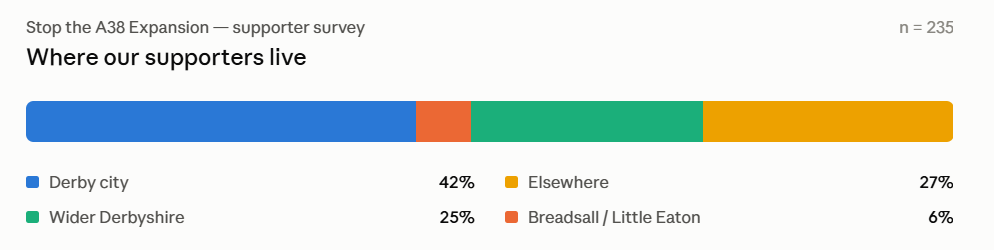
235 responses collected via public online form, August–September 2026.
99 respondents live in Derby itself,
13 in the Breadsall/Little Eaton area,
59 in the wider Derby/Derbyshire area,
and 64 elsewhere.
All 235 respondents consented to their response being used in this submission; 153 consented to be named if quoted, and 82 asked to remain anonymous. No individual respondent is identified in this response or in the accompanying spreadsheet without their consent.
Why support cancellation (free text, coded; respondents could cite more than one reason):
Won’t solve congestion/traffic 40%;
nature/biodiversity/trees 39%;
alternatives (public transport/active travel) 38%;
cost/value for money 37%;
climate/carbon 35%;
air quality/health 25%;
induced demand 12%;
community severance 7%;
noise 6%.
Maintain and repair existing roads as a higher priority than new road schemes:
strongly agree 65%,
agree 25%,
neutral 2%,
disagree <1%,
strongly disagree 8%.
Which RIS3 objective should be weighted highest:
environmental outcomes 43%;
safety 19%;
network performance/resilience 12%;
technology 5%;
economic growth explicitly named as lowest priority 1%.
Alternatives suggested (free text, coded):
rail/tram/train 32%;
bus 26%;
cycling/walking/active travel 25%;
park and ride 1%;
demand management/road pricing 1%.
On congestion, from a real-world commute constraint
"I drive because I can reliably get to my office in Derbyshire in 35 minutes by car, whereas by public transport it will take 1.15–2 hours. There are no buses from near my house to the railway station, I have to take two and change."
— Naomi Wilds
On congestion
"In my experience, traffic generally flows well on the A38 for the majority of the time. The main problems tend to occur during rush hour and these are often made worse by the behaviour and attitudes of some drivers rather than simply being caused by a lack of road capacity."
— Callum Bain, daily A38 driver (former telecoms engineer)
On the economic case
"The A38 Derby Junctions scheme would not contribute to growing the economy as it is a very low value scheme that would cause more harm than its supposed benefits."
— Clare Wood
On the economic case (RIS3 objectives)
"No. 1 is simply false. NH has never demonstrated this. I have only ever seen macroevidence to the opposite — GDP correlates negatively downstream of road construction. [...] Since road transport is subsidised to the extent of 3–4 times the total tax and duty take on the activity, there is no economic argument for meeting further demands for it."
— Chris Gillham
On alternatives (comparative evidence)
"Traffic reduction has been achieved in London, Paris, Oslo, Pontevedra and Ghent, to name but a few, by improving public transport and increasing cycling and walking alternatives. [...] Not expanding the A38 would also prevent the felling of wonderful trees around Markeaton Park, which is an important place where nature can heal and enhance people's lives."
— Godfrey Meynell
On climate
"We are in a climate emergency. We must drastically reduce our carbon emissions. Transport is a key emitter of carbon. [...] This is the time, this is the choice to turn and head in a different direction."
— David Clasby
On climate
"This is no longer something we can put off. 200–250 years of human fossil fuel use will have countless effects for us over the next 10–30 years and we have to act now in ways which help create a more liveable future habitat."
— Naomi Wilds
On cost and value for money
"Safety for all should be the highest priority, whilst maintaining the existing network, which may offer better value than expanding it when funding is constrained."
— Helen Foster
On nature and biodiversity
"It will reduce the value of local property and will damage the integrity of Markeaton Park, which is a much-beloved space significant to everyone in Derby. [...] It has been shown time and time again that projects such as these only increase the amount of cars and don't actually reduce or help traffic."
— Benjamin Grace
On nature and biodiversity
"It would also be madness to have a motorway-style road cutting through Derby and next to Derby's most-visited park."
— Clare Wood
On active travel specifically
"The scheme would degrade active travel provision, which is the opposite of what is needed right now. [...] We need to create transport solutions that enable more car-free journeys, rather than perpetuating the growth in motor-based transport, which road building schemes typically do."
— Tony Roelich
On air quality and health
"It won't reduce congestion but just generate more traffic. [...] We need to reduce cars on the roads to try and reduce transport carbon emissions, otherwise there will be no future for any of us and no one alive to use the expanded road."
— Sarah Fowler
Sources to be emailed
James Gleave, Mobility Lab "One Network for Derby" - Draft alternatives to the A38 Derby Junctions report
Supporter survey data in a spreadsheet
Sources with URL
ES Chapter 8 Biodiversity [APP-046]: https://nsip-documents.planninginspectorate.gov.uk/published-documents/TR010022-001207-6-1_ES_-Chapter_8(a)-_.pdf
Secretary of State's Decision Letter (paragraphs 68–72): https://nsip-documents.planninginspectorate.gov.uk/published-documents/TR010022-001535-230817%20A38%20Derby%20Junctions%20Decision%20Letter.pdf
Derby City Council Local Highway Impact Report, Section 8: https://nsip-documents.planninginspectorate.gov.uk/published-documents/TR010022-000814-DCiC%20LHIR.pdf
Statement of Common Ground with Derby City Council, p.52: https://nsip-documents.planninginspectorate.gov.uk/published-documents/TR010022-000841-TR010022_A38_8.7_SoCG_Derby_City_Council.pdf
TAG Unit M2.1, Variable Demand Modelling: https://assets.publishing.service.gov.uk/media/69a034423e672177d0bc7710/tag-unit-m21-variable-demand-modelling.pdf
National Pinch Point Programme meta-analysis: https://assets.publishing.service.gov.uk/government/uploads/system/uploads/attachment_data/file/791450/National_PP_Programme_Meta_Final_draft.pdf
Maid Marian Line SOBC: https://democracy.derbyshire.gov.uk/documents/s13523/Appendix%204%20Maid%20Marian%20Line%20Restoring%20Railway%20Strategic%20Outline%20Business%20Case.pdf
ORR financial monitoring: https://www.orr.gov.uk/sites/default/files/2025-08/annual-assessment-of-national-highways-performance-2024-2025-web.pdf
National Highways market engagement notice: https://www.find-tender.service.gov.uk/Notice/014582-2026
Metz (2017): https://www.sciencedirect.com/science/article/abs/pii/S2213624X16300876
DfT Value for Money Framework: https://www.gov.uk/government/publications/dft-value-for-money-framework
NTS 2024 household car access: https://www.racfoundation.org/motoring-faqs/mobility
Car access by income (Health Foundation): https://www.health.org.uk/resources-and-toolkits/data-tools/evidence-hub/trends-in-households-without-access-to-a-car
Car access and disability: https://www.gov.uk/government/statistics/national-travel-survey-2024/nts-2024-disability
What Works Centre for Local Economic Growth, transport review: https://whatworksgrowth.org/policy-reviews/transport/
Transport for Quality of Life's POPE review, via Campaign for Better Transport evidence https://committees.parliament.uk/writtenevidence/117665/pdf/
ES Chapter 14 – Climate: https://nsip-documents.planninginspectorate.gov.uk/published-documents/TR010022-000456-TR010022_A38_6.1_Environmental_Statement_Chapter_14.pdf
Drought declaration: https://www.gov.uk/government/news/drought-declared-in-half-of-england
OBR, Fiscal Risks and Sustainability: https://obr.uk/docs/dlm_uploads/Fiscal-risks-and-sustainability-report-July-2025.pdf
ES Chapter 5 – Air Quality: https://nsip-documents.planninginspectorate.gov.uk/published-documents/TR010022-000446-TR010022_A38_6.1_Environmental_Statement_Chapter_5.pdf
DfT, Decarbonising Transport (2021): https://www.gov.uk/government/publications/transport-decarbonisation-plan
EMCCA press release, £2bn fund: https://www.eastmidlands-cca.gov.uk/news/mayor-claire-ward-secures-largest-transport-investment-package-in-a-generation/
National Highways Annual Report 2025–26 (p.125): https://assets.publishing.service.gov.uk/media/6a54ecd3a4890e65cce64de4/Annual_report__and_accounts_2026.pdf
Centre for Cities, Measuring Up: https://www.centreforcities.org/publication/comparing-public-transport-uk-europe-cities/
NAO, road maintenance: https://www.nao.org.uk/reports/the-condition-and-maintenance-of-local-roads-in-england/
National Highways, A38 Derby Junctions project page: https://nationalhighways.co.uk/our-roads/east-midlands/a38-derby-junctions/